Unit 3.1. What is Water Governance? Principles of Water Governance
Instructor: Dr. Marirajan Thiruppathi
Associate Instructor: Dr. Nusrat Yaqoob
Water governance encompasses the political, social, economic, and administrative systems that influence water resource management and service delivery. It involves developing and implementing policies, legislation, and institutional frameworks that determine how water is used, protected, and distributed among stakeholders, including governments, private entities, civil society organizations, and local communities. Effective water governance is crucial for ensuring equitable and sustainable management of water resources and requires transparent decision-making processes, stakeholder participation, accountability mechanisms, and adaptability to changing environmental and socio-economic conditions (Kaushik et al., 2026; Pahl-Wostl, 2015).
The global water crisis is increasingly viewed as a governance crisis rather than a physical scarcity crisis. Effective governance provides the overarching framework — distinct from operational management — that sets objectives and ensures accountability. Ultimately, success depends on moving beyond "universal best practices" to adopt context-specific strategies that balance social, economic, and ecological goals (Woodhouse & Muller, 2017).
By the end of unit 3.1, participants will have a comprehensive understanding of water governance, including its definition, significance in resource management, and key components such as institutional arrangements, legal frameworks, economic and financial management, public participation, and sustainability considerations
Lecturer: Prof. Marirajan Thiruppathi
Lecture Topic: Foundations of Water Governance: Concepts, Principles, and Best Practices
Recorded Video: https://youtu.be/TqpdMT8brhA + https://youtu.be/jnvLVQMx9Zs
PPT File
3.1.1 Water Governance
Water governance refers to the political, social, economic, and administrative systems that influence water resource management and service delivery (UNESCO, 2015). It encompasses the policies, legislation, and institutions that shape how water is used, protected, and distributed among various stakeholders, including governments, private entities, civil society organizations, and local communities (OECD, 2015).
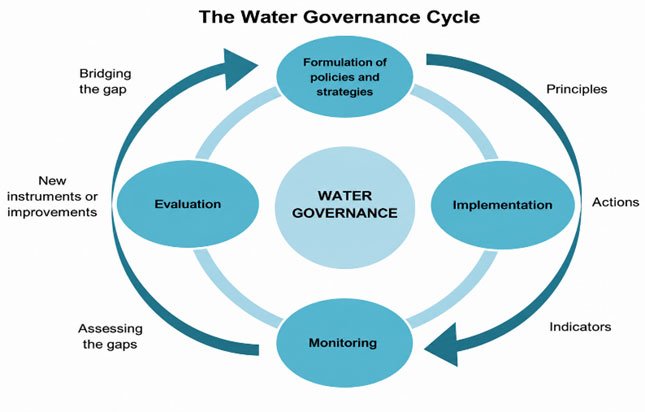
Figure 3.1.1: The water governance cycle Source: Keller, N., & Hartmann, T. (2020).
According to the Global Water Partnership (GWP, 2002), “water governance” is defined as: "The range of political, social, economic, and administrative systems that are in place to develop and manage water resources, and the delivery of water services, at different levels of society." The Organization for Economic Co-operation and Development (OECD, 2015) further highlights that effective water governance must address three key dimensions:
- Who does what? (Institutional roles and responsibilities)
- How is water managed? (Policy, regulatory, and legal frameworks)
- At what cost? (Financial and economic aspects of water governance)
Good water governance is essential for ensuring equitable and sustainable water resource management. It requires transparent decision-making processes, stakeholder participation, accountability mechanisms, and adaptability to changing environmental and socio-economic conditions (UN-Water, 2021; Rieiro et al., 2023; UNESCO, 2015).
3.1.2. Key Aspects of Water Governance:
From the above definitions, the following key aspects are included in water governance:
- The structure and roles of governance institutions, including governmental agencies, NGOs, and local communities, are included in institutional arrangements.
- Laws and regulations provide a legal framework that defines water rights, responsibilities, and access for different stakeholders.
- Economic and financial management is the allocation of resources and funding for water-related infrastructure, including sanitation and clean water supply investment.
- Public participation and stakeholder involvement: Inclusion of local communities, NGOs, indigenous groups, and the private sector in decision-making to ensure equity and sustainable practices.
- By ensuring sustainability and environmental considerations: long-term water resource availability, promoting water conservation efforts, and protecting aquatic ecosystems.
Group Discussion Exercise:
Analyzing Water Governance Challenges and Stakeholder Dynamics through video to foster critical thinking and collaborative analysis on water governance issues, emphasizing both local and global perspectives.
3.1.3 Principles of Water Governance
Effective water governance is guided by a set of principles that ensure the equitable, efficient, and sustainable management of water resources. These principles provide a framework for decision-making processes that involve multiple stakeholders, including governments, private entities, and local communities. According to UNESCO (2015) and OECD (2015), key principles of water governance include transparency, accountability, participation, effectiveness, efficiency, and sustainability (Rosso, 2025).
- Transparency is a fundamental principle in water governance, ensuring that policies, regulations, and decision-making processes are clearly defined and open to public scrutiny. Transparent governance mechanisms reduce corruption, enhance trust among stakeholders, and facilitate informed decision-making (OECD, 2015). For example, countries that establish open-access water data platforms and public consultations on water policies have demonstrated improved water management outcomes (UN-Water, 2021).
- Accountability is another crucial aspect, ensuring that institutions and policymakers are held responsible for their actions. Governments, water utilities, and regulatory bodies must adhere to legal and institutional frameworks that define their responsibilities in managing water resources (Global Water Partnership, 2002). Establishing independent regulatory agencies and community-based water monitoring systems strengthens accountability, thereby improving service delivery and resource management (UNESCO, 2015).
- Participation of various stakeholders, including local communities, civil society organizations, and marginalized groups, is essential in fostering inclusive water governance (OECD, 2015). Engaging diverse stakeholders ensures that multiple perspectives are considered in water-related policies and management strategies. Participatory approaches, such as community water boards and multi-stakeholder dialogues, have been successful in addressing water conflicts and promoting equitable access to water resources (UN-Water, 2021).
- Effectiveness and efficiency in water governance focus on the optimal use of resources through well-planned policies, institutional coordination, and the adoption of innovative technologies (World Bank, 2020). Effective governance frameworks integrate water management with other sectors, such as agriculture, energy, and urban planning, to enhance resource allocation and service delivery (OECD, 2015). Technological advancements, such as smart water meters and data-driven water management systems, have significantly improved water efficiency and conservation efforts.
- Sustainability is a core principle ensuring the long-term preservation of water resources. Sustainable water governance promotes environmental conservation, climate change adaptation, and integrated water resource management (UNESCO, 2015). Strategies such as watershed protection, pollution control measures, and adaptive policies help safeguard water ecosystems and maintain the balance between human and environmental water needs (Global Water Partnership, 2002).
Video: OECD Principles on Water Governance
Conclusion for Unit 3.1.
Applying these principles enhances the resilience and effectiveness of water governance systems worldwide. By prioritizing transparency, accountability, stakeholder participation, efficiency, and sustainability, policymakers and institutions can ensure equitable and sustainable water management practices that address present and future challenges.
Mandatory Quiz: [Click Here]
References
Kaushik, G., Kondekar, K., Aher, R., Dhage, G., Chel, A. L., Chaudhery, H., & Fatima, S. (2025).
Harmonizing water governance: Exploring governance structures, stakeholder engagement, and policy in water management. In S. Majumdar (Ed.), Advances in hydrology: Spatial intelligence, climate change, and sustainable water resource management (pp. 225–246). Elsevier. https://doi.org/10.1016/B978-0-443-26777-2.00013-2
Keller, N., & Hartmann, T. (2020). OECD water governance principles on the local scale–an exploration
in Dutch water management. International Journal of River Basin Management, 18(4), 439-444.
Organisation for Economic Co-operation and Development. (2011). Water governance in OECD countries:
A multi-level approach (OECD Studies on Water). OECD Publishing. https://doi.org/10.1787/9789264119284-en
Pahl-Wostl, C. (2015). Water governance in the face of global change: From understanding to
transformation (Water Governance—Concepts, Methods, and Practice). Springer. https://doi.org/10.1007/978-3-319-21855-7
Rieiro, F., Le Deunff, H., Jaraiseh, A., Thungren, G., & Giné, R. (2023). D2.2: Advancing water
governance: Reference guide for programming. InnWater/SIWI. https://www.innwater.eu/sites/default/files/delivrables/InnWater_D2.2_Reference_Guide_Programming%20VF%20PU.pdf
Rogers, P., & Hall, A. W. (2003). Effective water governance (TEC Background Papers No. 7). Global
Water Partnership (GWP). https://www.gwp.org/globalassets/global/toolbox/publications/background-papers/07-effective-water-governance-2003-english.pdf
Rosso, R. (2025). On the seven principles of water governance. Water, 17(6), Article 896.
https://doi.org/10.3390/w17060896
United Nations Educational, Scientific and Cultural Organization. (2015). Water for a sustainable world
(The United Nations World Water Development Report 2015). UNESCO. https://unesdoc.unesco.org/ark:/48223/pf0000231823
UN-Water. (2021). Summary progress update 2021: SDG 6 – Water and sanitation for all.
https://www.unwater.org/publications/summary-progress-update-2021-sdg-6-water-and-sanitation-all
Woodhouse, P., & Muller, M. (2017). Water governance: An historical perspective on current debates.
World Development, 92, 225–241. https://doi.org/10.1016/j.worlddev.2016.11.014