
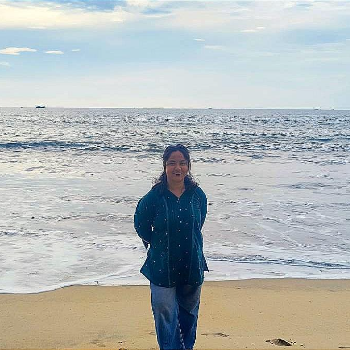
Syeda Tabassum Tasfia
1
Followers
0
Following


Education
- Masters in Environmental Science
Experiences
- Project Associate | Dec 2021 - Nov 2024| Rangewide Estimation of River Dolphins, Wildlife Institute of India
- Research Assistant | Dec 2019 - Nov 2021|CAMPA Dolphin, Wildlife Institute of India
- Project Assistant | Oct 2017 - Nov 2018 | CSIR- NEIST
- Research Internship | 01 June - 31 July 2015 CSIR-NEIST
About
Syeda Tabassum Tasfia is a mid-career ecologist with dedicated experience in freshwater ecosystem research and wildlife conservation. With over six years of research experience spanning extensive field and laboratory work, her work has focused on riverine biodiversity assessment and wetland conservation across India's major river systems.
She marked her research journey with her undergraduate research documenting ichthyofaunal diversity in a vanishing wetland ecosystem near her hometown in Assam– an experience that shaped her long-term interest in freshwater conservation. She later pursued graduate studies in Environmental Sciences at Tezpur University, where her graduate research project explored bioremediation approaches for removing heavy metal contamination from water using locally available plant biomass.
Tabassum’s professional career began with a year-long research assistantship at CSIR–NEIST, where she worked on in-vitro regeneration of underutilized aromatic plants with an emphasis on sustainable resource management. Following this, she was a full-time researcher at the Wildlife Institute of India (2019 to 2024), working on nationally significant wildlife conservation projects and contributing to India's largest freshwater biodiversity survey, which covered over 8,400 kilometres across the Ganga, Brahmaputra, Beas, and Chambal river basins. This work contributed to the first-ever range-wide population estimation of endangered Ganges and Indus River Dolphins in India. During this period, she co-developed standardized field methodologies for large-scale riverine surveys, conducted water quality and ecotoxicological assessments, and contributed to habitat restoration planning. Her research contributions include co-authoring technical reports, policy briefs, and peer-reviewed scientific publications.
Beyond research, she is committed to capacity building and knowledge dissemination. She has conducted Training of Trainers (ToTs) for forest department personnel, NGOs, and local communities across multiple Indian states, mentored graduate students in field research, and led community outreach initiatives at Ramsar wetland sites, including Harike Wildlife Sanctuary in Punjab. Recently, she served as a resource person at the Coasts and Oceans of Life festival organized by Azim Premji University, Bengaluru.
Her current research interests span Wetland Ecology, Riverine Ecosystems, Hydroecological Linkages, Bioremediation, and Habitat Restoration.
As an instructor, Tabassum aims to bridge academic understanding with ground-level realities– drawing from years of fieldwork across diverse riverine systems to share practical, real-world complex perspectives on water management challenges.
She marked her research journey with her undergraduate research documenting ichthyofaunal diversity in a vanishing wetland ecosystem near her hometown in Assam– an experience that shaped her long-term interest in freshwater conservation. She later pursued graduate studies in Environmental Sciences at Tezpur University, where her graduate research project explored bioremediation approaches for removing heavy metal contamination from water using locally available plant biomass.
Tabassum’s professional career began with a year-long research assistantship at CSIR–NEIST, where she worked on in-vitro regeneration of underutilized aromatic plants with an emphasis on sustainable resource management. Following this, she was a full-time researcher at the Wildlife Institute of India (2019 to 2024), working on nationally significant wildlife conservation projects and contributing to India's largest freshwater biodiversity survey, which covered over 8,400 kilometres across the Ganga, Brahmaputra, Beas, and Chambal river basins. This work contributed to the first-ever range-wide population estimation of endangered Ganges and Indus River Dolphins in India. During this period, she co-developed standardized field methodologies for large-scale riverine surveys, conducted water quality and ecotoxicological assessments, and contributed to habitat restoration planning. Her research contributions include co-authoring technical reports, policy briefs, and peer-reviewed scientific publications.
Beyond research, she is committed to capacity building and knowledge dissemination. She has conducted Training of Trainers (ToTs) for forest department personnel, NGOs, and local communities across multiple Indian states, mentored graduate students in field research, and led community outreach initiatives at Ramsar wetland sites, including Harike Wildlife Sanctuary in Punjab. Recently, she served as a resource person at the Coasts and Oceans of Life festival organized by Azim Premji University, Bengaluru.
Her current research interests span Wetland Ecology, Riverine Ecosystems, Hydroecological Linkages, Bioremediation, and Habitat Restoration.
As an instructor, Tabassum aims to bridge academic understanding with ground-level realities– drawing from years of fieldwork across diverse riverine systems to share practical, real-world complex perspectives on water management challenges.
Skills
Water
Biodiversity
Climate
Environment

Instructor doesn't have any course!
The instructor doesn't have any articles!
The instructor doesn't have any topics!
The instructor doesn't have any products!
Loyal User
1 year of Membership
